
How to Build a No-Code Platform: Architecture Guide
Table of Contents
- Introduction
- Choose a No-Code Platform Architecture Before Building the Editor
- No-Code Platform Architecture Models: Metadata-Driven, Code-Generation, or Hybrid?
- Core No-Code Platform Architecture: Builders, Workflows, and Connectors
- No-Code Platform Architecture for Runtime, Versioning, and Multi-Tenancy
- How to Build a No Code Platform MVP in Seven Steps
- Security, Permissions, Observability, and Deployment for Low-Code Platform Development
- Build Your Own No-Code Platform or Buy the Foundation?
- Conclusion
- Introduction
- Choose a No-Code Platform Architecture Before Building the Editor
- No-Code Platform Architecture Models: Metadata-Driven, Code-Generation, or Hybrid?
- Core No-Code Platform Architecture: Builders, Workflows, and Connectors
- No-Code Platform Architecture for Runtime, Versioning, and Multi-Tenancy
- How to Build a No Code Platform MVP in Seven Steps
- Security, Permissions, Observability, and Deployment for Low-Code Platform Development
- Build Your Own No-Code Platform or Buy the Foundation?
- Conclusion
Introduction
Learning how to build a no code platform means designing a safe way for customers to define software, not merely creating a drag-and-drop editor. TL;DR: The editor is visible, but reliable no-code platform architecture depends on schemas, workflow execution, permissions, integrations, versioning, deployment, and failure recovery.
MVP shortcuts can become architectural traps. A component library may validate demand quickly, while an unrestricted scripting engine creates a security and operations burden before product-market fit. An established reference point is Salesforce’s metadata-driven, multitenant platform architecture, where tenant-specific interfaces and business logic are represented as metadata on shared platform infrastructure.
- The three main architecture models
- A practical MVP sequence
- Security, scaling, and deployment boundaries
- When to build, buy, or combine components
Choose a No-Code Platform Architecture Before Building the Editor
Control Plane and Runtime Plane:
A no-code product has two planes. The control plane stores what users design: schemas, screens, workflows, permissions, connector settings, and versions. The runtime plane interprets or executes those definitions for end users. Keeping these planes separate lets you change the editor without destabilizing live applications.
A practical architecture contains these layers:
| Layer | Responsibility | MVP Shortcut | Scale-Ready Direction |
|---|---|---|---|
| Visual builder | Creates screens and data definitions | Fixed component palette | Extensible component registry |
| Metadata store | Saves application definitions | JSON documents | Versioned, validated metadata model |
| Workflow engine | Runs triggers and actions | Synchronous execution | Durable queues, retries, and idempotency |
| Connector layer | Calls external systems | Handwritten integrations | Typed contracts and credential isolation |
| Runtime | Renders and executes applications | Shared web process | Stateless workers with workload limits |
| Identity | Authenticates users and evaluates access | Hosted authentication | Tenant-aware roles and policy checks |
| Operations | Publishes and monitors releases | Manual deployment | Automated promotion and rollback |
First, decide what the platform promises. A form-and-approval builder has a narrower grammar than a general application builder. This constraint creates reliability.
An employee onboarding platform can begin with forms, conditional fields, approvals, email actions, and four connectors. It does not need arbitrary JavaScript, pixel-level page positioning, or customer-managed databases in its first release.
No-Code Platform Architecture Models: Metadata-Driven, Code-Generation, or Hybrid?
Teams building a no-code platform generally choose metadata-driven execution, code generation, or a hybrid. The key decision is what becomes the source of truth: a versioned application definition interpreted by a runtime, generated deployable code, or a controlled mix of both. Salesforce’s platform architecture guide provides a production-scale example of the metadata-driven model.
| Approach | How It Works | Strengths | Main Tradeoffs |
|---|---|---|---|
| Metadata-driven | Runtime interprets stored schemas and workflows | Fast publishing, central upgrades, consistent behavior | Runtime dependency and possible performance overhead |
| Code generation | Builder produces deployable source or binaries | Portable output and efficient runtime | Complex compiler, migrations, and regeneration conflicts |
Application Definition Execution Models:
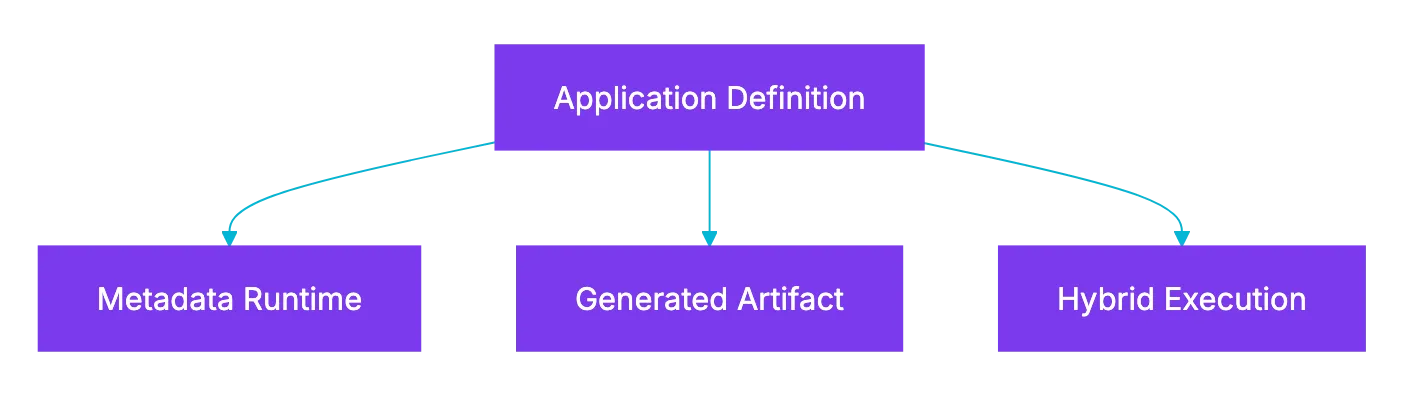
| Hybrid | Metadata handles common paths; code handles extensions | Practical balance of speed and control | Two execution models to secure and operate |
For most MVPs, choose metadata-driven execution with a small component vocabulary. A JSON application definition might reference a Form, Table, or ApprovalStep, while the runtime maps each type to tested implementation code.
Code generation makes more sense when customers require source ownership, offline deployment, or native mobile packages.
It raises harder questions: Can generated code be edited? Can edited code return to the visual builder? Which generator version produced a release?
A hybrid model often suits low-code platform development. Keep routine configuration declarative, then expose controlled extension points through APIs, webhooks, or sandboxed functions.
Core No-Code Platform Architecture: Builders, Workflows, and Connectors
The visual schema builder should describe data types, relationships, validation, defaults, and indexes without exposing database internals. Use stable internal identifiers because customers will rename visible fields. Renaming Customer Name must not break workflows that reference field ID fld_27.
The UI builder needs a component tree, not saved HTML. Each component definition should include:
- A stable type and version
- Accepted properties and validation rules
- Allowed parent and child components
- Data-binding capabilities
- Responsive layout behavior
- Permission and visibility conditions
CSS inheritance and free-form positioning can make visual editors behave unpredictably. Grid, stack, and container primitives are less glamorous than a blank canvas, but they produce more dependable applications and a smaller compatibility surface for the runtime.
Durable Workflow Lifecycle:
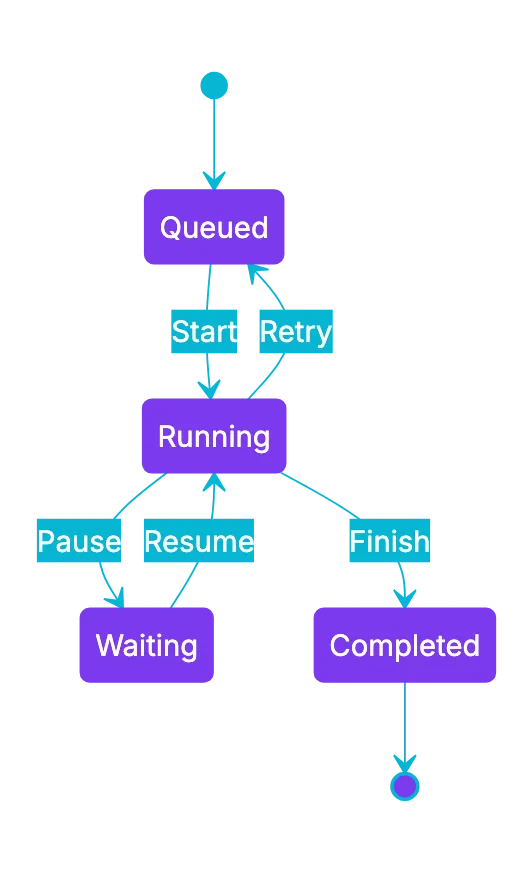
Treat workflows as durable state machines containing a trigger, conditions, steps, timeouts, and error paths. Every execution needs an ID, tenant context, input snapshot, current state, and audit history. Temporal’s guide to durable execution explains the core reliability principle: execution state must survive crashes so work can continue instead of restarting blindly. For an order-approval example, a payment action must use an idempotency token so a retry cannot charge twice.
Give connectors their own boundary. Each connector should declare:
- Authentication method and required scopes
- Input and output schemas
- Rate-limit and timeout behavior
- Retry eligibility
- Redaction rules for logs
Never let visual workflows handle raw credentials. Store secrets in a managed vault, reference them by opaque ID, and inject them only into isolated connector workers.
No-Code Platform Architecture for Runtime, Versioning, and Multi-Tenancy
Keep a scalable runtime stateless at the request layer. Application metadata, workflow state, and user data belong in durable stores, while queues absorb bursts and separate interactive requests from background jobs. CPU-heavy transformations should not share workers with page rendering.
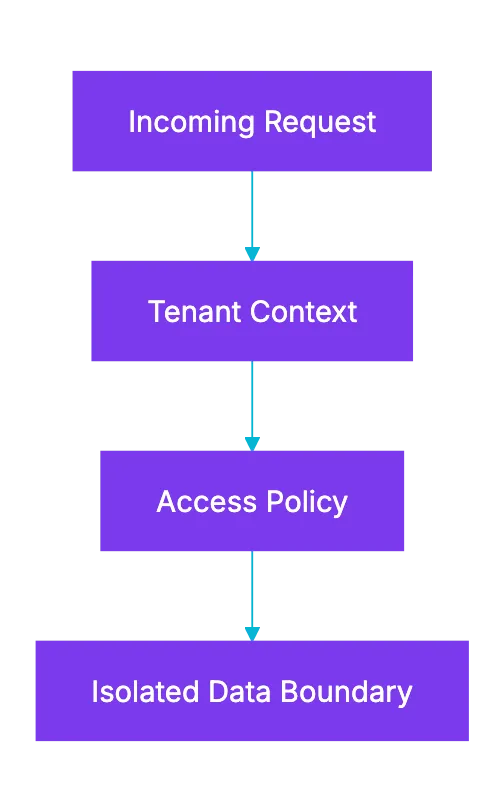
Multi-tenancy affects every query and cache entry. Add a tenant identifier at the data-access boundary, not separately in every feature. AWS treats tenant isolation as foundational to SaaS architecture: shared infrastructure is acceptable only when one tenant cannot access another tenant’s resources. PostgreSQL row-level security adds a guardrail but does not replace application authorization.
Larger customers may need dedicated databases or regional deployments, so do not assume all tenants will always share one physical store.
Choose isolation levels deliberately:
| Model | Cost | Isolation | Suitable Use |
|---|---|---|---|
| Shared tables with tenant IDs | Low | Logical | MVP and smaller customers |
| Separate schema per tenant | Medium | Stronger logical boundary | Moderate customization or restore needs |
Tenant-Aware Data Access:
| Separate database or deployment | High | Strong operational boundary | Large or regulated workloads |
Version metadata as immutable releases. Draft edits should create a new revision; publishing should point production to that revision atomically. Store the schema version, component versions, connector versions, and runtime compatibility range together.
For example, if a customer removes a field used by an active workflow, publication should fail validation or require an explicit migration. Quietly deploying a broken definition saves time only until support tickets arrive.
How to Build a No Code Platform MVP in Seven Steps
The MVP should prove users can create and operate one useful application category, not reproduce every feature of established platforms. Use this sequence:
-
Define the application grammar. Choose one use case, such as internal request portals. Specify supported data types, components, triggers, and actions.
-
Design versioned metadata. Create JSON schemas for applications, screens, fields, workflows, and permissions. Add stable IDs and a metadata version from day one.
-
Build the runtime before the polished editor. Prove that a hand-written definition renders, saves data, runs a workflow, and records an audit trail. This tests the risky execution model.
-
Add a constrained visual builder. Support selection, property editing, ordering, preview, validation, and undo. A tree or grid layout is sufficient for an MVP.
-
Put authentication and roles in place. Start with hosted identity, then add platform administrator, application builder, operator, and end-user roles. Evaluate permissions on the server.
-
Ship two or three connectors. Pick essential integrations. For an operations portal, email, Slack, and a generic webhook are more informative than 20 shallow connectors.
-
Add publishing and operations. Separate draft and production, run validation before release, retain rollback history, and expose execution logs.
Measure the platform with concrete service targets. An early product might aim for a p95 interactive latency below 500 milliseconds, workflow start within 5 seconds, and fewer than 1% failed executions, excluding user configuration errors. These are product-specific design targets, not universal benchmarks.
Security, Permissions, Observability, and Deployment for Low-Code Platform Development
Authentication identifies a user; authorization determines what they may do within a tenant, application, record, or field. Keep policy evaluation in the runtime and API layer because client-side visibility rules are presentation controls, not security controls.
Before admitting external builders, check:
| Item | What to Check | Why It Matters |
|---|---|---|
| Tenant isolation | Every query, queue message, cache key, and file includes tenant context | Prevents cross-customer data access |
| Permissions | Server checks roles and resource policies | UI restrictions can be bypassed |
| Secrets | Credentials are encrypted, scoped, rotated, and redacted | Connectors handle high-impact access |
| Input handling | Metadata and runtime inputs use allowlists and size limits | User-built applications are untrusted input |
| Extensions | Custom code runs with time, memory, network, and package limits | One extension must not control the platform |
| Audit history | Login, publish, permission, secret, and data-export events are recorded | Supports investigation and customer review |
| Recovery | Backups and tenant-level restores are tested | A backup is useless until restoration works |
Observability must link user actions to downstream work.
Propagate a correlation ID through API requests, workflow jobs, connector calls, and audit events. Record latency, queue age, retry count, connector errors, tenant-level resource consumption, and release version. Logs should show structured metadata while excluding passwords, tokens, and sensitive payloads.
Deploy immutable artifacts across development, staging, and production. Run metadata compatibility checks and smoke tests before promotion. Canary releases limit exposure, while feature flags separate deployment from availability. A 99.9% monthly availability target still allows about 44 minutes of downtime, so define recovery behavior as carefully as uptime.
Build Your Own No-Code Platform or Buy the Foundation?
You should build your own no-code platform when the builder itself creates product differentiation. If customers only need configurable forms or internal dashboards, buying a mature platform and adding custom services is faster.
| Decision Factor | Buy or Embed | Build | Hybrid |
|---|---|---|---|
| Unique visual language | Weak requirement | Strong requirement | Moderate requirement |
| Time to validate | Days or weeks | Months | Weeks to months |
| Infrastructure control | Limited | Full | Selective |
| Extension needs | Standard integrations | Proprietary execution | APIs plus custom workers |
| Engineering burden | Lower initially | Highest | Moderate |
| Migration flexibility | Vendor-dependent | Team-controlled | Depends on API boundaries |
Consider four scenarios:
- A startup testing a customer portal can use a hosted builder while keeping customer data and business rules behind its API.
- A manufacturer creating equipment-specific workflows may justify a custom schema and workflow editor because the domain model is the product.
- An internal operations team can combine Retool-style interfaces with existing services instead of funding a general-purpose platform.
- A multi-tenant SaaS company can use a custom metadata runtime while buying identity, queues, object storage, logging, and secret management.
This modular approach also creates an exit path when you build your own no-code platform. CodeStringers recommends separating the no-code UI, API, service, and persistence layers, then replacing pieces incrementally through a strangler pattern. That advice applies equally when you build your own no-code platform: stable APIs and exportable data reduce the cost of future changes.
Conclusion
Sound no-code architecture begins with a controlled application grammar, not a feature-packed canvas. Store user intent as versioned metadata, execute workflows durably, isolate tenants and secrets, and place custom code behind explicit extension boundaries. For efficient low-code platform development, hosted identity, databases, queues, and monitoring are sensible purchases unless one of them defines the product.
Before development, decide:
- Which application category the MVP supports
- Whether metadata, generated code, or a hybrid is the source of truth
- Which service levels and security boundaries the runtime must meet
Optimize the first release for learning and safe operation. Keep interfaces modular so successful components can scale and weak ones can be replaced. That separates a quick demo from a platform customers can trust.
Frequently asked questions
Can a no-code platform scale to thousands of users?
Yes, if the runtime supports concurrency, asynchronous work, isolation, and measured limits. User count is a poor sizing metric. Ten users running large imports may consume more resources than 10,000 users viewing cached pages. Test representative workflows and track p95 latency, queue age, database load, and connector quotas.
Should the platform generate code?
Generate code when portable artifacts, native performance, or customer-controlled deployment is required. For a web-based MVP, metadata-driven execution is usually easier to publish, upgrade, and observe. A hybrid architecture can add export later, but promise round-trip editing only if you are prepared to build a real parser and compatibility model.
How much custom code should low-code platform development allow?
Start with APIs and webhooks. Add sandboxed functions only when customers repeatedly hit the same limitation. Custom extensions need explicit permissions, resource quotas, dependency controls, network rules, logs, and kill switches.
How do permissions work in user-built applications?
Use several layers:
- Platform roles for administration and billing
- Builder roles for editing and publishing
- Application roles for end-user actions
- Resource policies for records, fields, files, and workflow steps
Default to denial when a policy is missing or invalid. Test permissions across tenant boundaries and with direct API calls.
What is the biggest MVP mistake?
Building a universal platform, followed by putting all execution in synchronous web requests. Narrow the grammar, queue background work, and make every published definition versioned and reversible.
What should I build first: the runtime or the visual editor?
Build a basic runtime first using hand-written application definitions. Confirm that it can render interfaces, save data, execute workflows, enforce permissions, and produce audit records before investing in a polished editor.
Why should the control plane and runtime plane be separate?
The control plane manages designs, settings, permissions, and versions, while the runtime serves published applications. Separating them allows editor changes and draft work to occur without destabilizing live customer applications.
How should field renames and schema changes be handled?
Reference fields and components through stable internal IDs rather than their display names. Before publication, validate changes against active workflows and either block incompatible releases or require an explicit migration.
How can workflow retries avoid duplicate actions?
Run workflows as durable state machines and record the state of every execution. External actions such as payments or record creation should use idempotency keys so retries do not repeat completed operations.
Where should integration credentials be stored?
Keep credentials in a managed secret vault and expose only opaque references to workflows. Inject secrets into isolated connector workers at execution time, with appropriate scopes, rotation policies, and log redaction.
Which tenant-isolation model should an MVP use?
Shared tables with mandatory tenant IDs are often sufficient for an early product when tenant context is enforced at the data-access layer. Separate schemas, databases, or deployments may become necessary for regulated customers, regional hosting, customized restores, or stronger operational isolation.
How should teams decide which platform components to build or buy?
Build the capabilities that create meaningful product differentiation, such as a specialized domain model or workflow language. Hosted identity, queues, storage, monitoring, and secret management are usually sensible purchases, provided they sit behind stable interfaces that preserve future migration options.