
Building a Secure Multi-Tenant No-Code Platform
Table of Contents
- Building a Multi-Tenant No-Code Platform Safely
- Tenant Isolation Is More Than Authentication
- Metadata-Driven Schemas for a Flexible No-Code Database
- Row-Level Security and Database Design
- Workflow Security for User-Created Automation
- Audit Logs, Rate Limits, and Tenant-Aware Operations
- Safe Migrations for Scalable SaaS Architecture
- Tenant Isolation and Workflow Security Pitfalls to Test
- Conclusion
- Building a Multi-Tenant No-Code Platform Safely
- Tenant Isolation Is More Than Authentication
- Metadata-Driven Schemas for a Flexible No-Code Database
- Row-Level Security and Database Design
- Workflow Security for User-Created Automation
- Audit Logs, Rate Limits, and Tenant-Aware Operations
- Safe Migrations for Scalable SaaS Architecture
- Tenant Isolation and Workflow Security Pitfalls to Test
- Conclusion
Building a Multi-Tenant No-Code Platform Safely
A multi-tenant no-code platform lets many organizations build applications on shared infrastructure. Sharing improves efficiency but imposes a hard rule: one tenant’s requests must never read, change, execute, or infer another’s data.
Secure SaaS architecture requires isolation beyond database rows. User-defined schemas, workflow jobs, files, caches, search indexes, logs, and third-party connectors all carry tenant context. One missing filter can turn an ordinary product bug into a serious security incident.
This guide maps a practical SaaS architecture covering tenant isolation, row-level security, metadata, workflows, migrations, rate limits, and audit logs, starting with an MVP that can mature without a rewrite.
- MVP priority: make tenant context mandatory and fail closed when it is absent.
- Production priority: add isolation in depth, workload controls, observability, and migration tooling.
- Operating principle: treat every identifier and workflow instruction from a client as untrusted input.
Source page reviewed in Chrome during article research. Follow the image link for the current page.
Tenant Isolation Is More Than Authentication
Authentication identifies the user, authorization defines permitted actions, and tenant isolation determines which organization’s resources an operation can reach. A valid, authenticated user can still exploit a broken object reference or a missing database predicate.
The AWS SaaS Tenant Isolation Strategies whitepaper describes isolation as fundamental to SaaS design and warns that shared infrastructure needs explicit controls preventing tenants from accessing one another’s resources. Although AWS labels the August 2020 paper historical, its isolation model remains useful; check service-specific details against current documentation.
AWS’s tenant-isolation whitepaper explains why isolation must be designed into a multi-tenant environment. Screenshot captured from the assigned primary source.
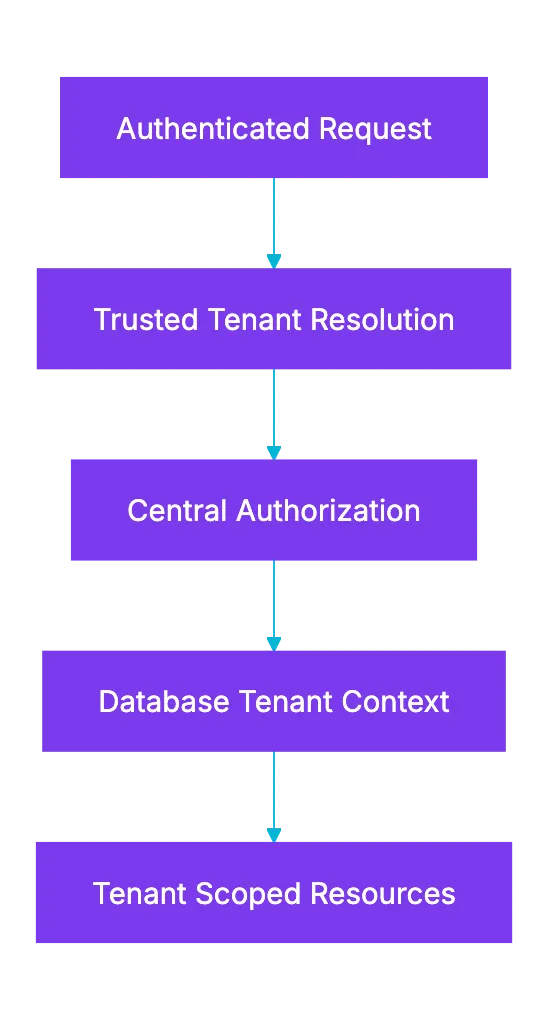
A secure multi-tenant no-code platform should use this request flow:
- The gateway validates the session or API token.
- The server resolves the tenant from trusted membership records, not a request parameter.
- A centralized authorization service checks the action, role, resource type, and tenant.
- The application opens a database transaction and sets tenant context.
- Row-level security applies the tenant boundary again.
- Storage, cache, search, and job operations use namespaced tenant keys.
- An audit event records the outcome and request identifier.
| Layer | Isolation Control | Concrete Failure to Test |
|---|---|---|
| API | Server-resolved tenant context | Changing tenant_id in a request succeeds |
| Database | Row-level security and tenant-scoped constraints | A query without a tenant predicate returns rows |
| Object storage | Tenant-prefixed keys and authorized signed URLs | One tenant reuses another tenant’s file URL |
| Cache and search | Tenant included in every key or filter | Cached results appear in another workspace |
Tenant Isolation Enforcement Path:
| Jobs | Signed, server-created tenant context | A worker accepts a client-selected tenant |
Metadata-Driven Schemas for a Flexible No-Code Database
Rather than shipping a hard-coded model for each new field, a no-code database stores user-defined structure as metadata-driven schemas. Metadata records tables, fields, types, relationships, validation rules, indexes, views, and permissions. A compiler converts approved schemas into controlled storage queries.
A practical metadata model includes:
- Application definitions: tenant, application, table, and current schema version.
- Field definitions: stable field ID, display name, type, nullability, default, and validation rules.
- Relationship definitions: source field, target table, cardinality, and delete behavior.
- Permission definitions: role, operation, field visibility, and optional record conditions.
- Published versions: immutable snapshots used by running forms, APIs, and workflows.
Do not use a user-entered label directly as a SQL identifier. Assign internal IDs, validate names separately, and generate parameterized queries with allowlisted types. Expressions should use a limited parser rather than raw SQL or general-purpose code.
There are three common storage approaches:
| Approach | Strength | Tradeoff | Best Fit |
|---|---|---|---|
| JSON documents in shared rows | Fast schema changes | Harder indexing and constraints | Early MVPs and sparse records |
| Entity-attribute-value tables | Uniform storage model | Complex queries and weak typing | Narrow, highly changing use cases |
| Generated physical columns or tables | Strong typing and query performance | Harder online migrations | Mature products with stable workloads |
A hybrid is often best. Keep common attributes such as tenant ID, record ID, timestamps, and ownership in typed columns. Initially store changing values in JSON, then promote frequently queried fields to indexed generated columns or dedicated tables.
Consider a customer adding a “Renewal date” field to a sales app. The platform should create a new metadata version, validate existing records, publish the version atomically, and let old workflow runs retain the version they started with. Silently changing an in-flight workflow’s meaning commonly damages data.
Row-Level Security and Database Design
Because developers can omit application filters, database row-level security provides a second enforcement point. In PostgreSQL, policies can restrict reads and writes by server-set tenant context.
Use this pattern:
- Resolve the user’s active tenant on the server.
- Begin a transaction using a restricted application database role.
- Set a transaction-local tenant value through the trusted connection path.
- Let row-level security compare each row’s tenant ID with that value.
- Clear context automatically when the transaction ends.
- Deny access when context is missing, malformed, or unknown.
Connection pooling requires care. Session-level settings can leak from one request to the next when a connection is reused. Transaction-local context reduces that risk. Administrative jobs should use separate controlled roles, not routinely bypass row-level security.
Tenant IDs must also participate in relational constraints. A records.table_id foreign key to tables.id is insufficient when IDs can mix across tenants. Prefer composite relationships such as (tenant_id, table_id) and make tenant ownership immutable through normal application paths.
| Database Check | What to Verify | Why It Matters |
|---|---|---|
| Default denial | Missing tenant context returns no rows or an error | Background jobs often omit request context |
| Write policies | Inserts and updates cannot assign another tenant | Read-only policies do not protect writes |
| Composite constraints | Related rows share the same tenant | Prevents cross-tenant references |
| Restricted roles | The app cannot disable or bypass policies | A policy is useless when the main role bypasses it |
| Pool safety | Context ends with each transaction | Stops tenant state leaking between requests |
Test isolation as a property, not just on sample endpoints. Create two tenants with similar IDs, generate reads and writes across every resource type, and assert that cross-tenant operations fail. Repeat those tests for REST endpoints, exports, search, background jobs, and administrator tools.
Workflow Security for User-Created Automation
Because workflows turn configuration into behavior, workflow security is a separate boundary. Workflows may read or update records, send email, invoke webhooks, process files, or use credentialed connectors; treat their definitions and inputs as untrusted.
A secure workflow flow is:
- An API request validates the actor and publishes an immutable workflow version.
- A trigger creates a job containing server-issued tenant, workflow, and event IDs.
- The queue routes the job to an isolated worker pool.
- The worker loads the published version and resolves its permission grant.
- Each step calls approved platform capabilities rather than the database directly.
- Time, memory, network, and retry budgets stop runaway execution.
Secure Workflow Execution:
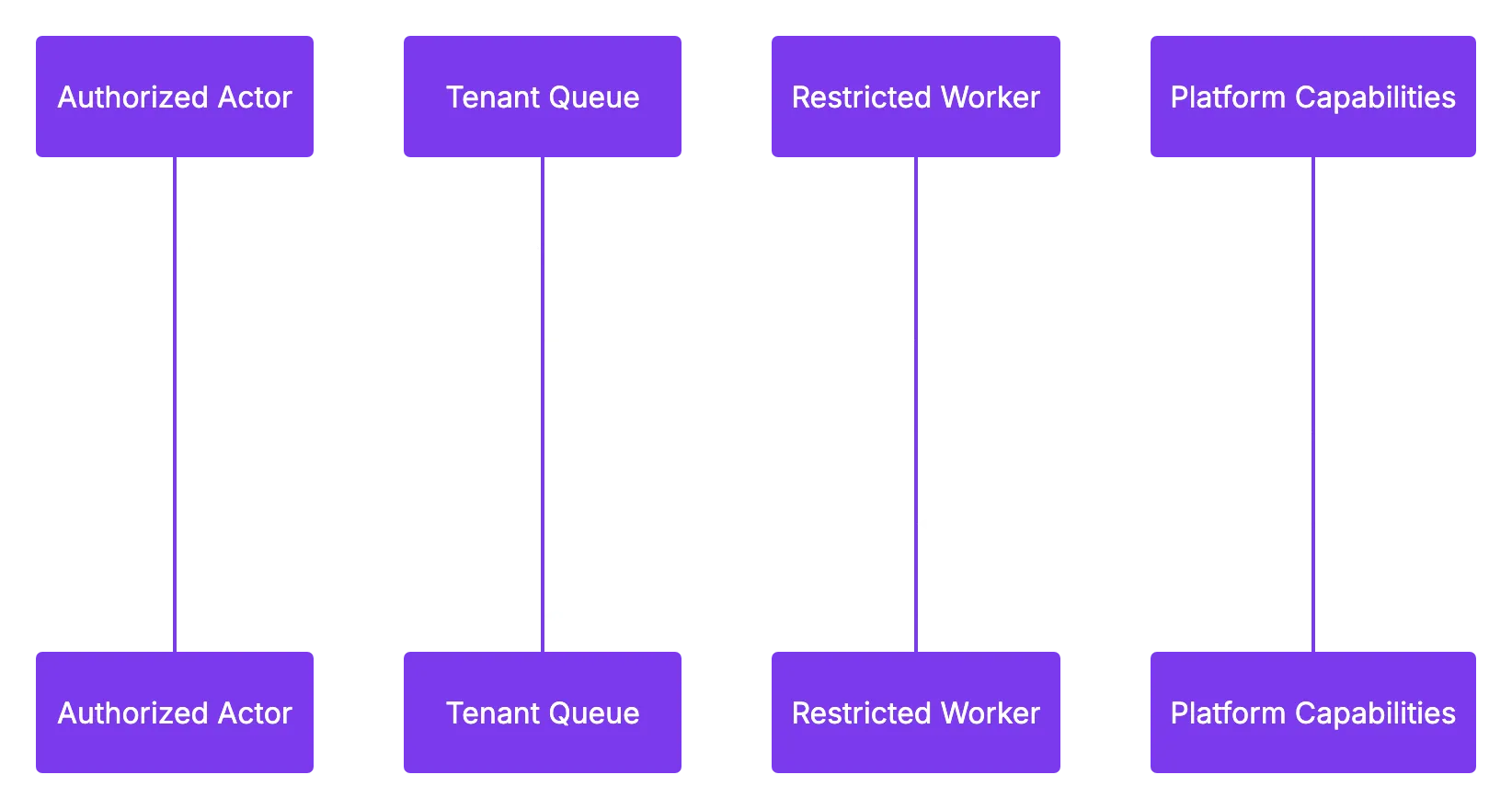
- The worker stores redacted results and emits an audit event.
Controls include:
- Capability grants: a workflow receives only the operations and fields it needs.
- Idempotency keys: retries cannot duplicate invoices, messages, or record creation.
- Execution ceilings: limit steps, duration, payload size, fan-out, and retry count.
- Egress rules: block private network ranges and restrict webhook destinations where appropriate.
- Secret references: inject connector secrets at runtime and never place them in definitions or logs.
- Loop detection: stop a workflow from repeatedly triggering itself.
Imagine a tenant importing 50,000 rows that each trigger an email workflow. Synchronous execution would delay the API and could flood the email provider. A production design batches events, applies a per-tenant concurrency limit, and places notifications on a dedicated queue. For an MVP, explicitly disabling triggers during bulk imports may be acceptable.
Webhook receivers should verify signatures, timestamp tolerance, replay identifiers, and the connector-to-tenant mapping before creating an event. A callback body’s tenant ID is never sufficient proof.
Audit Logs, Rate Limits, and Tenant-Aware Operations
Reliable audit logs show who changed schemas, published workflows, exported data, rotated connectors, or used administrative overrides; unlike debug logs, they record security-relevant actions. It should be structured, normally append-only, access-controlled, and subject to a documented retention policy.
Each audit event should contain:
- Tenant, actor, action, and affected resource.
- Timestamp plus request, trace, workflow, or job identifier.
- Authentication method and safe source context where useful.
- Result such as allowed, denied, failed, or completed.
- A redacted summary of changed fields, not complete sensitive values.
Do not record passwords, session tokens, connector secrets, or arbitrary request bodies. Audit-log readers need tenant isolation to prevent a new disclosure path.
Rate limits should cover several scopes to protect fairness and infrastructure.
| Limit Scope | Example Starting Policy | Purpose |
|---|---|---|
| User or API key | 120 ordinary requests per minute | Slows accidental loops and credential abuse |
| Tenant | 1,000 ordinary requests per minute | Preserves fairness on shared services |
| Workflow | 20 concurrent runs per tenant | Contains fan-out and noisy automation |
| Schema changes | 10 publications per minute | Protects metadata caches and migration workers |
| Platform | Capacity-based circuit breaker | Prevents overload from becoming an outage |
These numbers are starting points, not universal standards. Measure queue delay, database time, rejected requests, and 95th- and 99th-percentile latency before changing them. Return clear retry information and separate interactive traffic from bulk imports to keep large jobs from making applications unusable.
Tenant-aware observability closes the tenant isolation loop. Metrics and traces should carry a non-sensitive tenant identifier, workload class, schema version, and request ID. Dashboards should expose disproportionate queue usage and denied cross-tenant attempts without placing customer data in metric labels.
Safe Migrations for Scalable SaaS Architecture
Metadata changes are also migrations. Renaming a label is easy. Changing a text field into a number, deleting a relationship, or adding a uniqueness rule can invalidate stored records and active workflows.
Use a staged migration lifecycle:
- Draft: edit a private metadata version and validate identifiers, types, expressions, and permissions.
- Plan: calculate affected records, indexes, workflows, APIs, and estimated work.
- Backfill: transform data in bounded, resumable batches while the previous version remains readable.
- Publish: atomically move the application to the new schema version.
- Observe: monitor errors, rejected records, workflow failures, and query latency.
Schema Migration Lifecycle:

- Retire: remove compatibility code only after rollback and retention windows expire.
Converting an “Employee count” text field to an integer should not mutate every record during an HTTP request. Create the representation, backfill valid values, quarantine exceptions for tenant review, then switch readers. A reversible migration stores enough information to return to the earlier version.
A practical maturity path:
| Stage | Architecture | Acceptable Shortcut | Required Guardrail |
|---|---|---|---|
| MVP | Shared app, shared database, queued workers | Changing values stored in JSON | Mandatory tenant IDs, centralized authorization, RLS, basic audit logs |
| Growth | Versioned metadata, separate workload queues | Shared tables remain | Tenant quotas, migration jobs, cache isolation, tenant-aware tracing |
| Scale | Partitioned data and specialized worker pools | Some tenants remain pooled | Automated isolation tests, regional controls, capacity management |
| Enterprise | Selective dedicated databases or infrastructure | Shared control plane | Consistent authorization and audit semantics across deployment models |
Dedicated infrastructure can meet unusual performance or isolation requirements but increases provisioning, migration, monitoring, and cost management. A sound multi-tenant SaaS architecture supports pooled and dedicated data planes behind the same authorization contract. Do not default to “one database per tenant” because isolation sounds simpler; thousands of small databases create their own operational burden.
Tenant Isolation and Workflow Security Pitfalls to Test
The most dangerous defects often occur between components. A well-filtered API can still enqueue an unsafe job, and a correctly protected database can still leak a signed file URL.
| Pitfall | What to Check | Why It Matters |
|---|---|---|
| Client-selected tenant | Tenant comes from trusted membership resolution | Request fields can be changed by an attacker |
| Unscoped lookup | Resource queries include tenant ownership | Globally unique IDs are not authorization |
| Cache collision | Every key contains tenant and permission context | Cached data can bypass database controls |
| Unsafe schema compiler | Identifiers and expressions use allowlists | User metadata can become injection input |
| Worker privilege drift | Jobs receive limited capability grants | Background services often have broad access |
| Log leakage | Logs and traces redact values and secrets | Operational systems copy data widely |
| Migration race | Readers pin a published schema version | In-flight requests may interpret data differently |
| Admin bypass | Support access is approved and audited | Internal tools can defeat otherwise sound isolation |
Before launch, run negative tests in which tenant A guesses tenant B’s record, file, workflow, job, export, and schema IDs. Test list and detail endpoints equally. Then remove tenant context and confirm each layer fails closed.
Also rehearse an incident: suspend a tenant token, stop its workflow jobs, find affected requests by trace ID, and export the audit trail. If that exercise requires improvised database access, the operational design is not ready.
Conclusion
A secure multi-tenant no-code platform requires trustworthy, mandatory tenant context enforced independently at every boundary; authentication alone is insufficient. Centralized authorization, database row-level security, tenant-scoped storage and caches, and cross-tenant negative tests provide isolation in depth.
Store user-defined structures as versioned metadata, compile them through controlled code, and migrate data with observable, reversible jobs. Run workflows in restricted workers with explicit capabilities, quotas, idempotency, and safe secret handling. Use append-only audit logs and tenant-aware metrics to trace failures.
A shared database and JSON-backed records can be reasonable MVP choices. Missing isolation, unrestricted workflows, and irreversible schema changes are deferred incidents, not shortcuts. Build the security contract first, then scale storage and infrastructure.
Frequently asked questions
How should the platform handle users who belong to multiple tenants?
Resolve the active tenant from verified membership records and require an explicit, server-validated tenant switch. Never trust a tenant ID submitted by the client without confirming that the user belongs to that organization and has permission to perform the requested action.
Can signed file URLs create cross-tenant security risks?
Yes. Generate signed URLs only after checking tenant ownership and keep their permissions and expiration times narrowly scoped. Tests should confirm that one tenant cannot request, reuse, or refresh a URL for another tenant’s file.
How can connection pooling be used safely with tenant context?
Set tenant context locally within each database transaction so it disappears when the transaction ends. Avoid persistent session settings that could remain on a pooled connection and affect a later request from another tenant.
What should happen when a schema migration encounters invalid records?
Process migrations in resumable batches and separate records that cannot be converted automatically. Keep the previous schema readable, let the tenant review exceptions, and publish the new version only when validation and rollback requirements are satisfied.
How should bulk imports interact with workflows and rate limits?
Place imports on dedicated queues, process records in bounded batches, and apply tenant-level concurrency limits. Depending on product requirements, workflow triggers can be disabled during import or aggregated to prevent thousands of duplicate notifications and downstream requests.
How can support staff access tenant data safely?
Use a separate, time-limited support-access process that requires authorization, records the reason, and grants only the necessary scope. Every access and administrative override should produce an audit event that the security team and, ideally, the affected tenant can review.
What isolation tests should run before each release?
Create at least two tenants and attempt cross-tenant access to records, files, searches, caches, workflows, jobs, exports, and schema definitions. Include missing-context, guessed-identifier, write, list, and administrative-tool cases, and verify that every layer fails closed.
Is user authentication enough to guarantee tenant isolation?
No. Authentication confirms identity; tenant isolation prevents access to another tenant’s resources. Enforce isolation independently at the API, service, database, storage, and cache layers, following the principles in the AWS SaaS Tenant Isolation Strategies whitepaper.
How should a no-code platform store flexible user-defined schemas?
Store table, field, relationship, validation, and permission definitions as versioned metadata, not arbitrary application code. Validate every schema change and compile metadata into controlled queries or storage operations to prevent unsafe identifiers, broken relationships, and injection vulnerabilities.
Where should row-level security be enforced?
Apply tenant filters in application queries and again in databases that support row-level security. Set tenant context through a trusted server-side connection path, never from a client-supplied tenant ID, and test that missing context fails closed.
How can user-created workflows run safely?
Execute workflows in isolated background workers with explicit permissions, timeouts, retry limits, and idempotency controls. Treat expressions, webhooks, and connectors as untrusted; prevent loops, forged callbacks, secret exposure, and cross-tenant execution.
What should be included in an audit log?
Record the tenant, actor, action, affected resource, timestamp, request or workflow identifier, and a safe summary of the change. Keep audit records append-only and restricted; omit passwords, access tokens, and unnecessary sensitive values.
Should rate limits apply per user or per tenant?
Limit users or API keys for abuse control, tenants for fairness, and the platform for infrastructure protection. Give bulk imports, workflow runs, file processing, and schema changes separate quotas so one workload cannot exhaust shared capacity.
What is a practical path from MVP to a production-scale platform?
Begin with a shared application and database, mandatory tenant identifiers, centralized authorization, database-backed isolation, queued workflows, and basic audit logging. As usage grows, add metadata versioning, reversible migrations, tenant-aware observability, quotas, partitioning, and dedicated infrastructure for stronger compliance or performance needs.